Before There Was Code, There Was the Colony
Table of Contents
The most elegant algorithms in computer science weren't invented. They were observed — in colonies, in slime, in the desperate mathematics of survival.
Here is a fact that should bother you more than it does.
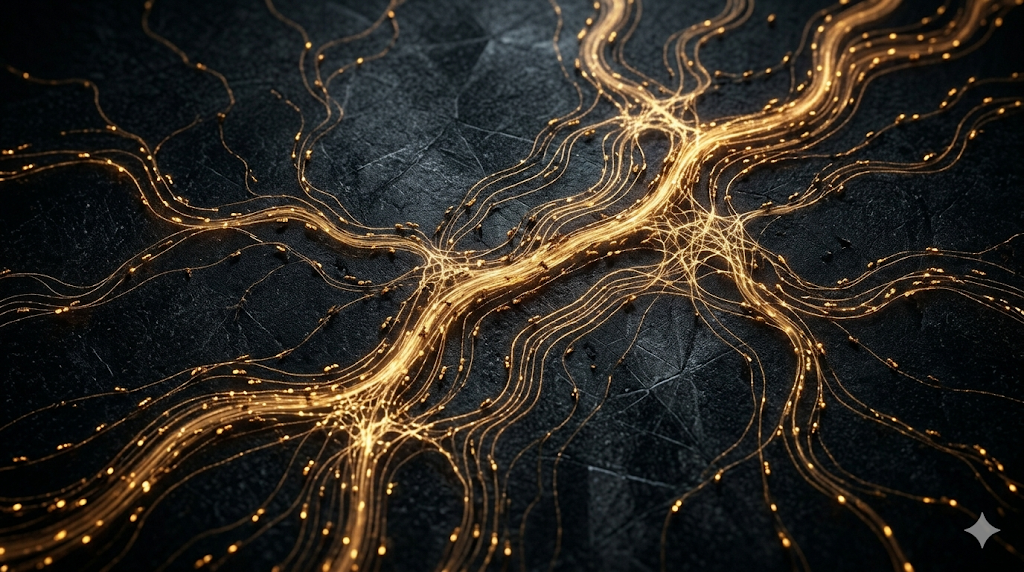
In 1992, a PhD student named Marco Dorigo was staring at ants. Not metaphorically. Literally watching Argentine ants wander around, bump into each other, and somehow — collectively, without a foreman, without a Jira ticket, without a single ant having any idea what the colony was doing — find the shortest path between food and home every single time.
He wrote his thesis about it. He called it Ant Colony Optimization. It went on to become one of the most widely used algorithms in combinatorial optimization, applied everywhere from logistics routing to chip design to protein folding.
The ants did not receive co-authorship.
This is the strange, slightly humbling story of how nature kept solving problems that computer scientists hadn't figured out yet — and how we eventually had the good sense to just copy the homework.
The ant doesn't know it's optimizing
Here's what's actually happening when ants find the shortest path, because it's more elegant than any whiteboard explanation.
An ant leaves the colony. It has no map, no GPS, no centralized intelligence feeding it directions. It wanders, essentially at random, laying down a chemical trail — pheromone — as it moves. When it finds food, it heads back, laying more pheromone on the return trip.
Other ants, sniffing the air, tend to follow stronger pheromone trails. A shorter path gets traversed faster. Faster traversal means the pheromone gets reinforced more frequently. More pheromone attracts more ants. More ants means more pheromone. The shorter path wins — not because any ant decided it, but because the math of reinforcement and evaporation made it inevitable.
There's no CEO ant. There's no planning meeting. There's just feedback, chemistry, and time.
Analogy It's the same reason a path forms in a lawn when people keep cutting across it. Nobody decided to build a path there. Nobody drew a blueprint. The grass just died where the pressure was highest, and what remained was the emergent consensus of a thousand separate decisions. The ant colony is just running that algorithm faster, with chemicals instead of dead grass.
Dorigo formalized this into code. Instead of pheromones, you have weights on graph edges. Instead of evaporation, you have a decay function that stops the algorithm from committing too hard to one solution. Instead of ants, you have agents traversing a solution space. The result: a system that finds near-optimal solutions to problems — like the Travelling Salesman Problem — that would take classical algorithms an eternity to brute-force.
The ant solved it in millions of years of evolution. Dorigo packaged that solution in a PhD thesis. Roughly same timeline, different overhead costs.
The slime mold that out-planned Tokyo's engineers
If ants feel too clean and structured, let me introduce you to Physarum polycephalum — a slime mold, a single-celled organism with no brain, no nervous system, and the aesthetic of something you'd scrape off a log. It is, genuinely, one of the most interesting things in computer science.
In 2010, a team of Japanese researchers led by Toshiyuki Nakagaki ran one of the most quietly devastating experiments in recent scientific history. They placed oat flakes on an agar plate in the positions of major cities around Tokyo. They placed a blob of slime mold at the position of Tokyo Station. And they waited.
The slime mold spread. It sent tendrils toward every oat flake simultaneously — essentially exploring all routes in parallel. Then it began to optimize. Tendrils carrying more flow grew thicker. Tendrils carrying little flow thinned and retracted. Gradually, a network emerged.
When they compared the slime mold's final network to the actual Tokyo rail system — the one engineered over decades by humans with advanced tools, substantial budgets, and presumably a lot of meetings — the two were nearly identical.
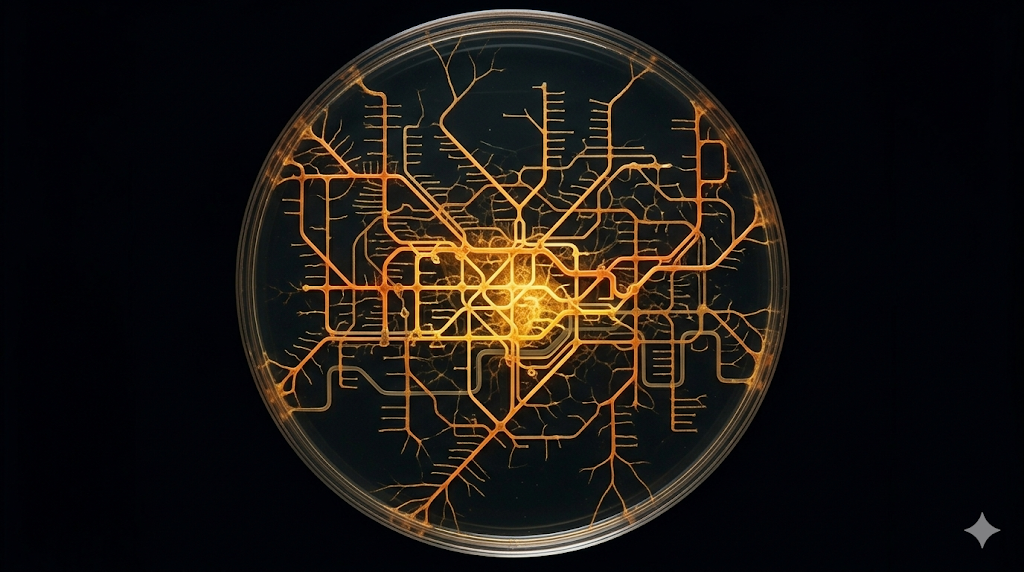
Cost efficiency. Fault tolerance. Network robustness. The slime mold, without a single neuron, had independently converged on solutions that took human engineers decades to arrive at through deliberate design.
"A brainless blob, given only local feedback and time, produced infrastructure that mirrored what took human civilization decades to engineer."
Nakagaki won the Ig Nobel Prize for this. Twice. The computer science implications are real. The algorithm extracted from slime mold behavior is now used to design resilient network topologies. Road networks. Internet routing. Power grids. The slime mold is not credited on the patents.
Three rules, infinite complexity — what birds taught graphics
In 1986, a computer animator named Craig Reynolds asked a question that sounds simple: how do you make a flock of birds look real?
The naive answer is to script each bird individually. Laboriously animate every wingbeat, every turn, every spacing decision. This is how it was done before Reynolds. It was expensive, unconvincing, and exhausting.
Reynolds had a different idea. What if each bird just followed three rules?
- Separation: don't crowd your neighbors.
- Alignment: steer toward the average heading of your neighbors.
- Cohesion: move toward the average position of your neighbors.
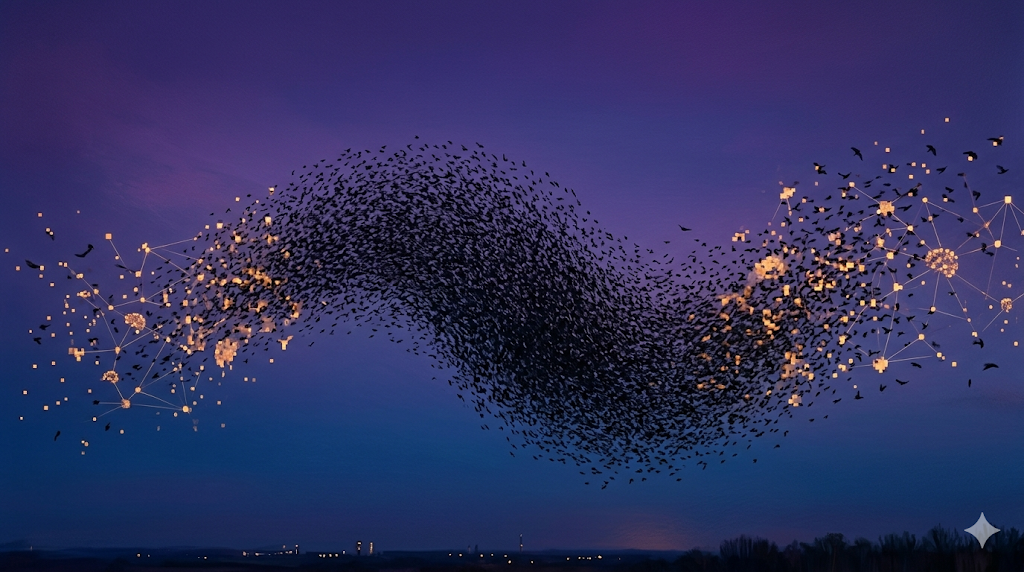
The result produced behavior so realistic it was used in Batman Returns, The Lion King, and countless games. But the computer science implications go further than animation. Three simple local rules producing globally coherent complex behavior is the definition of emergent computation — and it maps directly onto distributed systems design and multi-agent AI architectures.
Analogy A load balancer that routes traffic based on server health signals is Boids. A mesh network that reroutes packets around a failed node is Boids. A multi-agent AI system where each agent follows local context to produce globally coherent task execution is Boids.
Evolution wrote the original algorithm
All of this points at something worth sitting with. Ants, slime molds, birds — these are not primitive systems. They are sophisticated algorithms, shaped by billions of years of selection pressure that ruthlessly eliminated every approach that didn't work.
Evolution is, at its core, a search algorithm. It explores solution spaces through mutation and selection — a process so general that when we formalized it as Genetic Algorithms in the 1970s, we found it could optimize anything from neural network weights to antenna shapes.
"Nature doesn't have a computer science department. It just had four billion years to brute force the solutions, and the decency to leave them lying around for us to find."
What this actually means for how you think about algorithms
If you're studying algorithms in a CS program and thinking about them purely as mathematical constructs, you're missing something important.
The most powerful algorithms we have are often observations. Someone watched ants and saw graph traversal. Someone watched slime mold and saw network optimization. Someone watched birds and saw distributed consensus.
This has practical implications for what comes next. Neuromorphic computing, Swarm robotics, and Reservoir computing are all dissolving the boundary between what is biological and what is computational. It turns out they were always the same thing, just running on different hardware.
The ant still doesn't know it's optimizing
Intelligence, it turns out, doesn't require awareness of itself. Optimization doesn't require intent. And sometimes the most sophisticated system in the room is one that has no idea it's in a room.
Everything is, at some level of abstraction, just the slime mold. Spreading out. Reinforcing what works. Letting what doesn't work quietly retract.
Not a bad algorithm, all things considered.