Your Brain is a Terrible Hard Drive — Heres the Fix
Table of Contents
You have consumed thousands of hours of lectures, papers, tutorials, and late-night YouTube rabbit holes. You remember almost none of it. This is not a personal failure. It's a hardware problem.
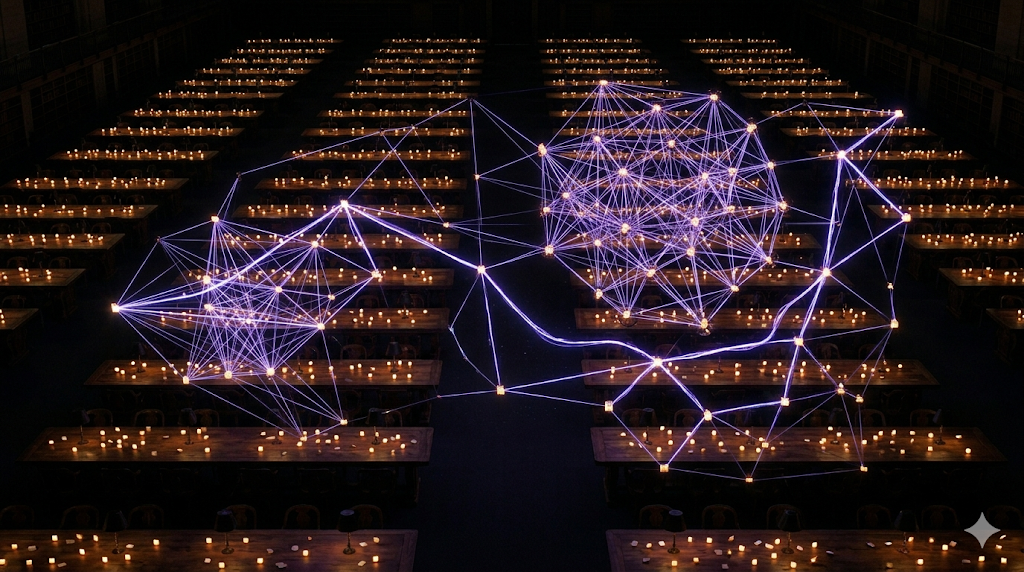
Let me describe your relationship with information right now.
You attend a lecture. You take notes — good ones, actually. You highlight, you star things, you write "IMPORTANT" in the margin. You understand it in the moment. You leave the room genuinely feeling like you've learned something.
A week later, someone casually asks you about it. You open your mouth and discover that what you have is the shape of the memory — the feeling that you once understood this — but not the substance. The detail is gone. The intuition you built in that classroom has evaporated like it was never there.
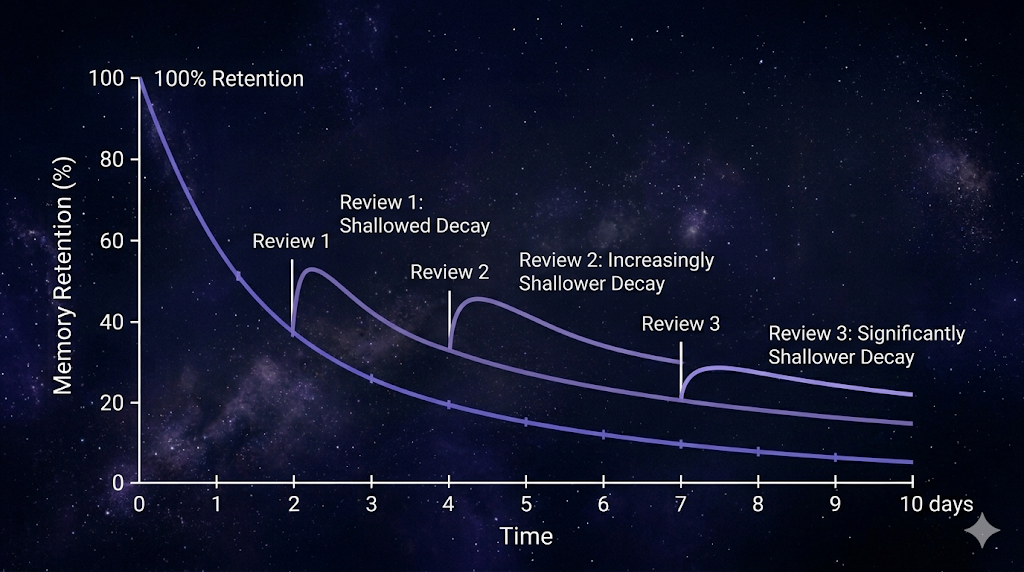
Hermann Ebbinghaus, a German psychologist working in the 1880s, ran experiments on himself to map this exactly. He measured how quickly he forgot newly learned information with no reinforcement. The result — the forgetting curve — is one of the most uncomfortable graphs in all of cognitive science. Within 24 hours, humans forget roughly 70% of new information they've encountered. Within a week, up to 90%.
You are not bad at studying. Your brain is just running the wrong software for what being a knowledge worker in 2026 actually demands.
The hardware problem nobody talks about
Your brain was not designed to be a filing cabinet. It was designed for survival — pattern recognition, threat detection, social navigation. Abstract facts, technical concepts, framework names — these are not things your brain has any particular evolutionary incentive to keep around.
Working memory holds roughly four chunks of information at once. Not forty. Not four hundred. Four. Every time a new semester starts, or you pick up a new domain, your brain is trying to cram more into those four slots than they were ever meant to hold.
The result is a predictable failure mode: you understand something while you're learning it, you forget it before you need it, and then you re-learn it from scratch. This cycle costs you an enormous amount of time and energy.
Analogy Your brain is like RAM — fast, powerful, limited, volatile. Everything in RAM is gone when you close the program. A second brain is persistent storage — slower to access, but permanent. The goal isn't to replace RAM with disk. It's to make sure the things worth keeping actually get written to disk.
What a second brain actually is — and isn't
The term "second brain" was popularized by Tiago Forte around 2022. By 2025, it became a movement, with tools like Obsidian crossing 1.5 million users.
But let's be precise: A second brain is an external system where you store, connect, and retrieve your thinking. The goal is not to build a beautiful archive. The goal is to make your past thinking available to your future thinking.
"The goal isn't a beautiful archive. The goal is to make your past thinking available to your future self — when you actually need it."
The idea that changed how I think about notes
In the 1960s, Niklas Luhmann developed a system called the Zettelkasten — German for "slip box." The principle: one idea per note, every note links to other relevant notes. No folders. No hierarchy.
This is the intellectual DNA behind modern PKM tools. Luhmann's insight — that knowledge compounds when you force ideas into conversation with each other — predated the internet by decades.
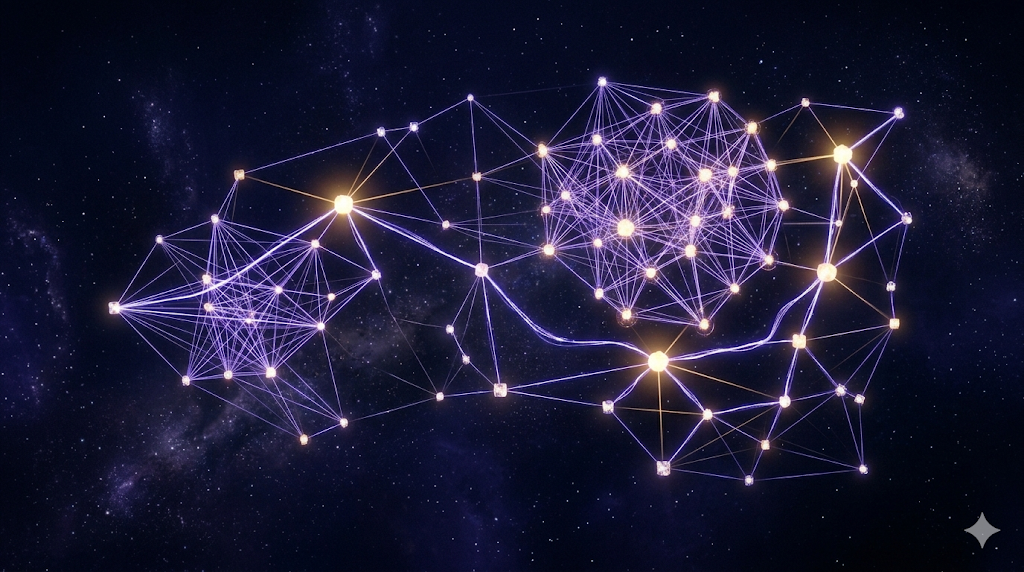
Analogy A folder of unlinked notes is like a bag of puzzle pieces. A Zettelkasten is the assembled puzzle. Connections are where the meaning is. And when you add a new piece, you're not just storing it — you're discovering where it belongs.
What this looks like practically, as a CS student
A second brain for a CS student is not a productivity aesthetic. It is, practically, three things:
- A capture habit: Write it down immediately, in one place.
- A linking habit: Ask "what else does this connect to?" and spend thirty seconds backlinking.
- A review habit: A quick weekly review flattens the forgetting curve through spaced repetition.
The part most people skip
The people who actually benefit from second brains are not the ones with the prettiest graph views. They're the ones who captured something ugly at 11pm, and three weeks later found it while working on something different, and suddenly the two ideas clicked.
The second brain is not a better filing cabinet. It is a thinking partner built from your own past reasoning, available on demand, that gets smarter the longer you use it.
Start small. One note today. One link tomorrow. The graph will come.